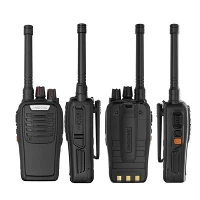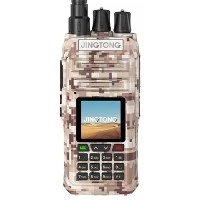

The signal range of an analog walkie talkie in an open field is a crucial factor for many users, especially those who rely on these devices for communication in various scenarios such as outdoor activities, security operations, and industrial work. As a supplier of analog walkie talkies, I have received numerous inquiries about this topic. In this blog, I will delve into the factors that affect the signal range of analog walkie talkies in an open field and provide some insights based on our products.
Understanding the Basics of Analog Walkie Talkies
Analog walkie talkies operate on specific frequency bands, typically in the VHF (Very High Frequency) and UHF (Ultra High Frequency) ranges. These devices use analog signals to transmit and receive voice communications. Unlike digital walkie talkies, which convert voice into digital data, analog walkie talkies send the audio signal directly in its original form.
The power output of an analog walkie talkie is measured in watts. Higher power output generally means a longer signal range. Our company offers a variety of analog walkie talkies with different power outputs, including the 5W UHF Analog Handheld Radio Walkie Talkie and the 5w UHF VHF Two Way Radio. These products are designed to provide reliable communication in different environments.
Factors Affecting Signal Range in an Open Field
Frequency Band
VHF and UHF are the two main frequency bands used by analog walkie talkies. VHF signals (30 - 300 MHz) have longer wavelengths and can travel farther in open spaces. They are better at penetrating obstacles such as trees and buildings. However, VHF signals are more susceptible to interference from natural phenomena such as lightning.
UHF signals (300 - 3000 MHz) have shorter wavelengths and are more suitable for use in urban areas or environments with many obstacles. They are less likely to be affected by natural interference but may have a shorter range in open fields compared to VHF signals.
Power Output
As mentioned earlier, the power output of a walkie talkie is a significant factor in determining its signal range. A higher power output allows the device to transmit the signal over a longer distance. Our Analog Two Way Radio with a 5-watt power output can typically achieve a longer range in an open field compared to a lower-powered device.
Antenna Design
The antenna is an essential component of a walkie talkie as it is responsible for transmitting and receiving the signals. A well-designed antenna can significantly improve the signal range. Our analog walkie talkies are equipped with high-quality antennas that are optimized for maximum performance. The length and type of antenna can also affect the signal range. For example, a longer antenna generally provides a better range, especially for VHF frequencies.
Terrain and Environmental Conditions
Even in an open field, the terrain and environmental conditions can have an impact on the signal range. For instance, a flat and unobstructed field will allow the signal to travel farther compared to a field with hills, valleys, or large bodies of water. Atmospheric conditions such as humidity, temperature, and wind can also affect the signal propagation. In general, dry and calm conditions are more favorable for long-range communication.


Typical Signal Ranges in an Open Field
Based on our experience and testing, the following are the typical signal ranges for our analog walkie talkies in an open field:
- Low-power (1 - 2 watts): These devices can typically achieve a range of 1 - 3 miles in an open field. They are suitable for short-range communication, such as within a small park or a construction site.
- Medium-power (3 - 4 watts): With a medium-power output, the signal range can extend to 3 - 5 miles. These walkie talkies are ideal for outdoor activities such as hiking or camping, where you may need to communicate over a moderate distance.
- High-power (5 watts): Our 5-watt analog walkie talkies can reach a range of 5 - 10 miles in an open field. This makes them suitable for more extensive operations, such as large-scale security patrols or agricultural work.
It's important to note that these ranges are approximate and can vary depending on the factors mentioned above. In real-world scenarios, the actual signal range may be shorter due to various obstacles and interference.
Tips to Maximize Signal Range
- Choose the Right Frequency Band: Consider the environment where you will be using the walkie talkie. If you are in an open field with few obstacles, VHF may be a better choice for longer range. If you expect to encounter more obstacles, UHF may be more suitable.
- Optimize Antenna Placement: Make sure the antenna is fully extended and positioned vertically. Avoid blocking the antenna with your body or other objects.
- Reduce Interference: Try to operate the walkie talkie away from sources of interference, such as power lines, electrical equipment, or other radio devices.
- Maintain Battery Life: A fully charged battery ensures that the walkie talkie operates at its maximum power output, which can help improve the signal range.
Conclusion
The signal range of an analog walkie talkie in an open field is influenced by several factors, including the frequency band, power output, antenna design, and terrain. As a supplier of analog walkie talkies, we strive to provide high-quality products that offer reliable communication over a reasonable range. Our 5W UHF Analog Handheld Radio Walkie Talkie, 5w UHF VHF Two Way Radio, and Analog Two Way Radio are designed to meet the needs of different users in various environments.
If you are interested in purchasing our analog walkie talkies or have any questions about signal range or other features, please feel free to contact us for a detailed discussion and procurement negotiation. We are committed to providing you with the best communication solutions.
References
- Radio Frequency Engineering Handbook
- Communication Electronics: Principles and Applications